My favorite Numberphile video, A 1.58-Dimensional Object, explores what I think is one of the coolest ideas in mathematics: that the dimension of an object doesn’t have to be an integer. A line is 1-dimension, a square is 2D, and a cube is 3D. But consider the Sierpiński triangle. It looks like a 2D shape, but it’s punctured with so many holes (seemingly an infinite amount). Does a shape like this deserve to be called 2-dimensional? It turns out that in fact, its dimension is $\log_2 3 \approx 1.585$.
This post is my attempt to unpack this idea.
What Does Dimension Mean?
A common intuition is that dimension indicates how many numbers is needed to specify a point. For example, a point on a line needs 1, a point in the plane needs 2, and a point in (our) space needs 3. This is the topological dimension.
But there’s another way to think about it, based on scaling. If you double the side length of a line segment, you get $2^1 = 2$ copies. Doubling the side of a square gives you $2^2 = 4$ copies, and doubling the side of a cube yields $2^3 = 8$ copies.
Clearly, there’s a pattern. If scaling by a factor $s$ gives $N$ self-similar copies, then:
\[N = s^d \implies d = \frac{\log N}{\log s}\]For ordinary shapes this gives exactly the integer dimension we expect, but for self-similar fractals, $d$ does not have to be an integer.
The Hausdorff Dimension
This scaling argument is made rigorous by the Hausdorff dimension, introduced by Felix Hausdorff in 1918.
Instead of scaling up (like doubling the side lengths of a square), we can instead think about scaling down. Suppose we take a shape and break it into $N$ smaller copies of itself, each scaled down by a factor $r<1$. In 1D, lengths scale by $r$. In 2D, areas scale by $r^2$. In 3D, volumes scale by $r^3$. So in general, for a $d$-dimensional object, “size” scales by $r^d$. That means each small copy has $r^d$ times the size of the original. If we say the original shape had size $1$, then since there are $N$ smaller copies making up the whole, we must have:
\[N \cdot r^d = 1\]Solving for $d$ get us:
\[d = \frac{\log N}{\log(1/r)}\]The Sierpiński Triangle: $d \approx 1.585$
Take an equilateral triangle. Divide it into four congruent smaller triangles and remove the central one. Repeat forever on each remaining triangle.
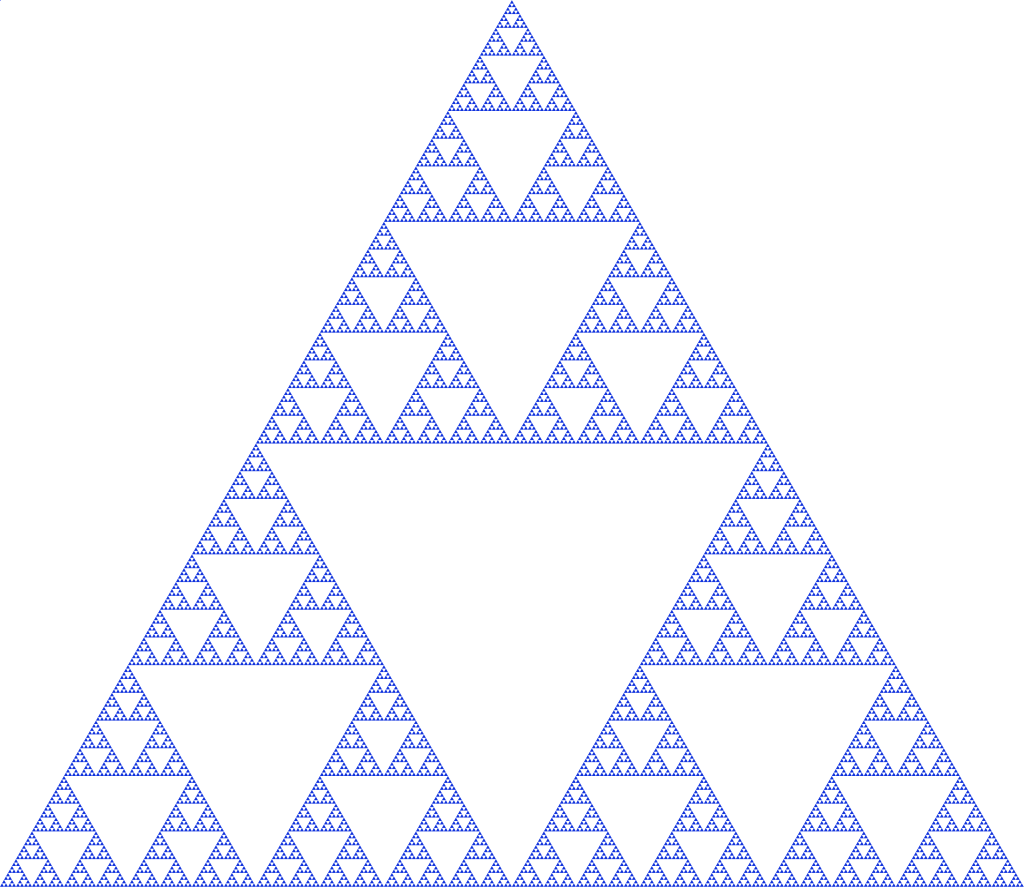
At each step, each triangle becomes $N = 3$ copies, each scaled by $r = 1/2$. Plugging in:
\[d = \frac{\log 3}{\log 2} \approx 1.585\]It’s more than a curve but less than a surface. Its area must be zero, since at each iteration keeps only $\frac{3}{4}$ of what remained, so after $n$ steps the area is $(3/4)^n \to 0$, but it’s not 1-dimensional either. The number $1.585$ captures exactly how much of the plane it occupies.
We can also construct this shape via a game:
- Pick the three vertices of a triangle.
- Start at any point inside.
- Pick a random vertex, move halfway toward it, plot the point.
- Repeat forever.
Despite the randomness, this procedure converges to the Sierpiński triangle.
Imaginary Cubes
This is the part of the Numberphile video that blew my mind.
The Sierpiński tetrahedron is the 3D analogue of the Sierpiński triangle: shrink a tetrahedron to half size, make 4 copies, connect them at their corners, and repeat. Its Hausdorff dimension is:
\[d = \frac{\log 4}{\log 2} = 2 \quad ???\]This is weird. The shape is clearly a 3D construction, yet it has the same dimension as a flat surface? It gets weirder.
When you project the Sierpiński tetrahedron onto a plane perpendicular to one of its axes, its shadow exactly fills a square. Every point in the square is covered, with no gaps and no overlaps. A fully 3D hollow fractal casting a completely solid 2D shadow.
We’ll call this an imaginary cube.
Here’s an interactive demo of a Sierpiński tetrahedron1. Drag it around and see if you can find angle where it looks like a full 2D square.
Sierpiński tetrahedron · d = log 4 / log 2 = 2 · drag to rotate
This the kind of beautiful mathematics I can’t stop thinking about.
-
Special thanks to Claude Sonnet 4.6 for graciously generating the code for this demo. ↩